
I’ll never forget that moment. I was surfing my FB newsfeed when Dad exclaimed, “Kalam no more?”
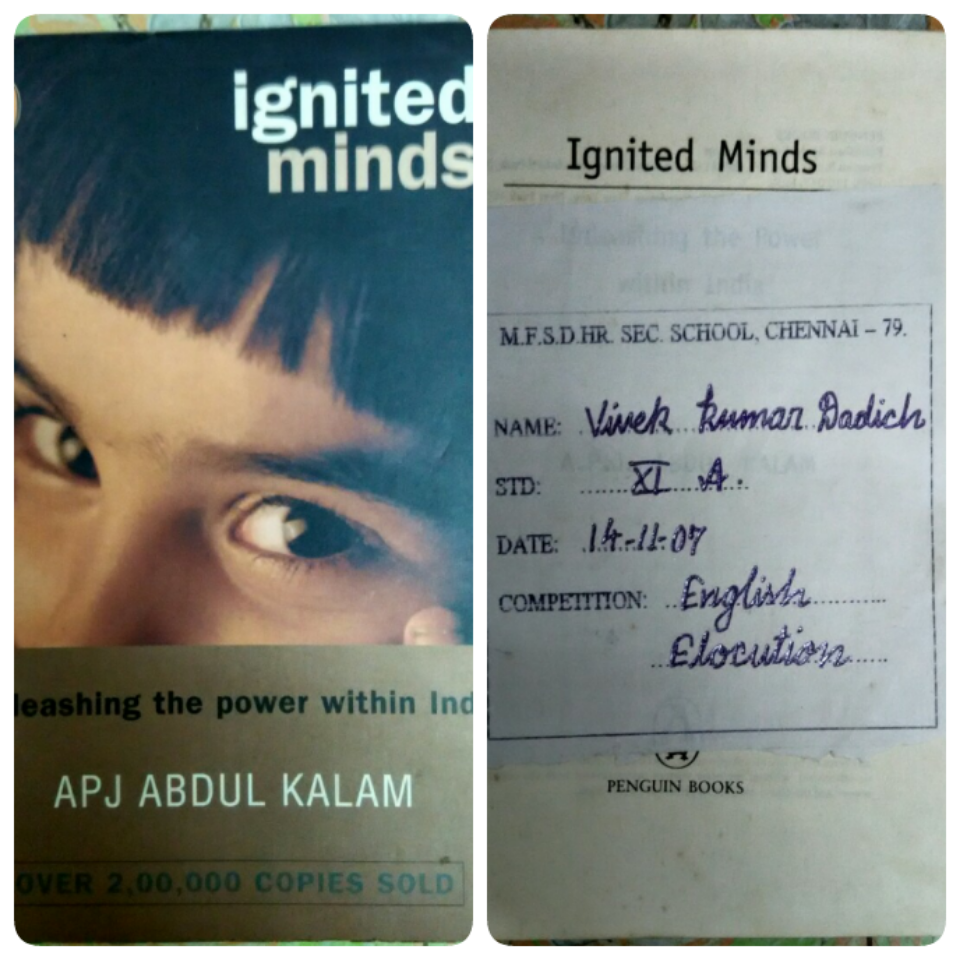
I rushed out, and was hysterical. I was smirking, my eyes were moist, my legs were giving away, words failed me. 09:02 pm the time was. Words are failing me, as if I were an infant struggling to convey my thoughts. I let the world know what I thought of that moment, and went in recluse in my room. I remembered that I had a book written by Kalam with me. I couldn’t remember the name, and I was cursing myself for that. I, I felt guilty that I forgot the name of the book! I ransacked my room to find that one slender book, on the cover of which is a girl with shining eyes. I found it.
I kept that book in front of me, and stared at it. This is my Kalam. Who says Kalam is dead? He is here, with me! “Ignited Minds”, his book to the children of India is a singular non-fiction book I read when I was young and was developing an appetite for reading. I opened the book, and there it was. A felicitation written on a piece of paper and stuck on the 2nd page. I had won it at an inter school Elocution Competition on the Children’s Day in 2007. It is my prized possession.
Now, I’ve known Kalam to be an endearing personality. Only after he became the President did the world look up to him and his achievements, and the hardships he went through. You can wiki all of that. But, you can’t wiki how he felt when he faced it, and when he conquered it all. Labelled as the “Missile Man of India”, this one man morphed the Indian Politics when he was elected indirectly as the President of the Republic of India.
A man of such a stature, that no one dare bad-mouth him. He was a modern Bhishma, and he was a devout Muslim. I’ve read it somewhere; sweep so well that even the Gods say “Here lived a great sweeper who did his job well”. Kalam — whose name is synonymous with ‘Kalam’ (pen in Hindi) was true to his name and fame. I went to Rameshwaram for pilgrimage in 2005, and the driver eagerly let us know that Kalam’s house is nearby. My parents and my relatives shrugged to the idea of visiting his house, I insisted.
One would’ve thought that the President of India’s house would at least be painted well. There it was, a rusted green fenced door which guarded the family of the 1st Citizen of India. Strangely, and honestly, I did not expect a bungalow of a house. And, my expectations weren’t hurt. I just stood there for a while, emulating it, staring at it. I didn’t even knock on the door. I didn’t need to.
I’d have read “Ignited Minds” for a good 3 times I guess. I’ll be reading it again tonight. I’m feeling lost. I’m feeling alone. I need Kalam with me. I seldom cry, I seldom cry.
Then I saw this movie titled “I am Kalam”, and it told the story of a poor kid who names himself Kalam and wishes to be like Kalam. He adopts his hairstyle, his ways, and studies by hook or crook. He even hitch-hikes his way to the Rashtrapati Bhavan to deliver a hand-written letter to His Excellency. I watch that movie — that movie with all fantastical elements — and I feel part of it. How I wish I were that kid, who’d go to any length to emulate his role model.
Page 86 of “Ignited Minds”, second paragraph reads, “In Kanchi, I was privileged to see Vedic recitation and recitations from the Quran proceeding side by side”. You feel it? That humility, curiosity, love for one’s country, and respect for all religions; he shaped me in more ways than one. And all the secularists in the sub-continent don’t hail his name, which is understandable. He is not for sale.
Of course, Ayn Rand, Paulo Coelho, and Herman Hesse also shaped my life and character; but I’ve never had a sense of belonging with any of them as I had with Kalam. When I read his words, it’s as if he is speaking to me, to us. He is no more now. He is one with the Force. I felt a strong impulse to go to Rameswaram and visit his home back, but now was not the time. Kalam would ask me, “Who are you?” to which I have no answer. I must become, I must be more than what I am in order to stand in front of that rusted green fenced door.
I feel privileged to have lived in Kalam’s lifetime. Decades from now, I will have stories to tell — of character, of selflessness, of integrity, of Kalam.
 Refuge