
AIDS – The Medical Untouchability

On a rainy Sunday morning, I woke up late. I relieved myself and sat with the newspaper. Page 2, an awareness advertisement caught my eye.
“Why don’t you share chocolates with me?”
That was the question asked by a cute toddler infected with AIDS. I think, post these scientific advancements and the internet revolution (we have the world in our fingertips!); we are – after all – still naïve.
Turning to page 7, I read a confession of a prominent film personality. It read, “I went to an old man’s home to give him some clothes. I knew he had AIDS. He was kind enough to offer me some snacks. I ate it hesitantly. I left and never returned to that home. I was afraid.”
My  mind began to flash back to early 2007, when I was young enough to not know about AIDS. We had a programme in school wherein they were spreading awareness about AIDS. There were presentations on the reasons, precautions, among others. One of the presenters went a step forward and introduced us a young lad. He was vibrant and enthusiastic, he held the microphone for the first time! We all had lunch with him together. He laughed and made us laugh on his jokes. In the afternoon session, the presenter revealed to us that the lad had AIDS. First, there was a loud gasp which echoed the hall. A kid shouted, “what?! Even I’ll get AIDS!”. A girl moaned, “I shook hands with him. Now, nobody will talk to me!”. I thanked God that the lad was not there to listen to these remarks.
The presenter then reiterated, “we have explained this to you already. AIDS does not spread through hand-shakes, sneezing, having lunch together. AIDS only spreads congenitally, through unsafe sexual contact and blood transfer. . .”. The programme went on.
It later struck me that I did not understand one specific term. But, the presenters were long gone. So, I asked, “what is unsafe sexual contact?”. “go home! Don’t ask bad questions!”, came the reply from the learned biology teacher.
2013, here I am. Fully informed and aptly educated. So are my friends. But; I still notice hesitations and reservations whenever a topic like this surfaces. You know the problem in India? AIDS can be easily controlled here. More than half of the IND population is literate, there are homes here with no toilets but not without mobile phones. Such is the penetration of technology. The social taboo, the hesitation in deliberating on sex education is what the problem is. At least the women and girls receive sex education to some extent from their mothers (with respect to sanitation and hygiene). But, the boys are left to cope up with their problems and predicaments on their own. Society begins at home. And; at home, the minute an AIDS awareness advertisement is showcased, the channel is changed.
I can hardly imagine the plight of the AIDS patients. Some have acquired it because of their own fault, some have no fault of theirs. What kind of ambience are we giving them, when they are treated like untouchables in every walk of their life — from renting an apartment, to visiting shrines to getting a job?!And all these reservations, knowing that AIDS is not contagious!
A drop of tear rolled down my eye and fell on the sweet face of the toddler on the newspaper. The paper absorbed it, leaving wrinkles on the toddler’s face. The newspaper had served its purpose, have we?!
Haiyan Episode – Pitfalls and Options Explored

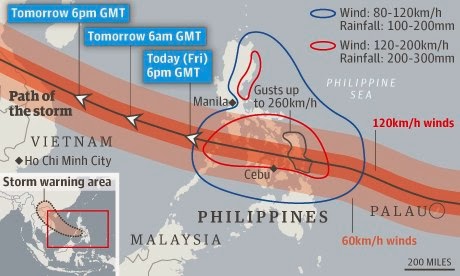
Philippines is an archipelago of 7107 islands with 98 million inhabitants. Since independence; its population has increased 7 fold, making it the 12th most populated nation of the world. It is recently in news because it became the playground of one of the most powerful cyclone, Haiyan (category 4). But; was it only the speed of the cyclone which literally erased towns and cities? History is replete with facts that Philippines have been devastated by cyclones regularly. In fact, this is the 4th cyclone it faced in 2013. And; if we add the earthquake in Visayas region (the same region where Haiyan played havoc), then in 203 alone it faced 5 disasters! Haiyan has rendered any immediate relief measures futile. So, what led to, or aggravated to the situation?
 
Topographically, the Philippines is broken up by the sea, which gives it one of the longest coastlines of any nation in the world. Situated on the western fringes of the Pacific Ring of Fire, it experiences regular quakes and seismic activity. An important point here is that it sits astride the Typhoon belt, and consequently suffers an annual onslaught of dangerous storms from July through December. Since Philippines is an archipelago and does not have a vast stretch of continuous land, there is little which can be done to abate the cyclones’ intensity. The country has vast coral reefs, and mangrove covers demarcating the coastline. But; due to recent urbanization, pollution and mining activities the natural vegetation is drastically declining. Mountain ranges once covered with sprawling forest covers are now visibly bald.
A good majority of the locals reside in the coastal areas and the population distribution is uneven, owing to the mountainous landscape of some islands (like Luzon). The country’s birth rate has been significantly higher than the world average, and the highest in Asia. Due to the population and urbanization, the coastal cities and towns extend beyond its limits. It is given that Philippines has given itself adequate infrastructure in order to protect civilian lives and minimize the damage. The measures include sea walls, cyclone shelters, and information & warning systems. Sometimes, such measures aren’t good enough.
Today, we have excellent forecasting systems, by virtue of which we can detect cyclone formation days in advance. Philippines is also equipped with warning systems. The gap arises in evacuation. It so happens that when cyclones (like Haiyan) are forecasted to tread through the archipelago, it becomes difficult to evacuate the inhabitants to safe havens. The nation should invest intelligently in bringing strong and durable cyclone shelters and embankments. In such situations, education plays a pivotal role. Arrangements should be made to make sure that the inhabitants are educated to help themselves (and others) in times of crisis. They should be trained to manage disastrous situations like flash floods, fire, landslides among others. They should be given guidelines on the kinds of food items to procure to help them sustain for longer periods of time.
National Disaster Coordination Council (NDCC), the apex body of the disaster mitigation in Philippines should be prepared with contingency and crisis plans and should conduct regular drills to gauge the level of preparedness. Disaster mitigation measures also include effective rehabilitation of the victims. This forms a difficult task, because of the trauma faced by the inhabitants. Measures should be taken to ensure that the connectivity and electricity is restored at the earliest possible time. This will ensure that the search & rescue operations are carried out at a faster pace and will result in expedition of the relief measures. After all, we are deliberating about the typhoon mat of Asia!
V.k. Dadhich
  
Bibliography: